Renting a Movie in 2024? Inside America's Last Blockbuster, Where Browsing Still Means Something
There's a blue-and-yellow sign glowing above a strip mall in Bend, Oregon, and it's not a relic or a photo op. It's a functioning video rental store. This is the last Blockbuster on the planet — the final holdout after roughly 9,000 locations across America went dark — and on any given weekend, you'll find tourists from Texas, Ohio, and New York wandering the aisles like it's a museum they're allowed to touch.
Except it's not a museum. People actually rent movies here. Actual physical discs, taken home, rewound (when applicable), and returned. And the strangest part of the whole story isn't that the store survived. It's that what it offers — the thing thousands of pilgrims drive hours for — is exactly what the streaming industry has spent the last decade deleting.
The Shelf Doesn't Have a Profile for You
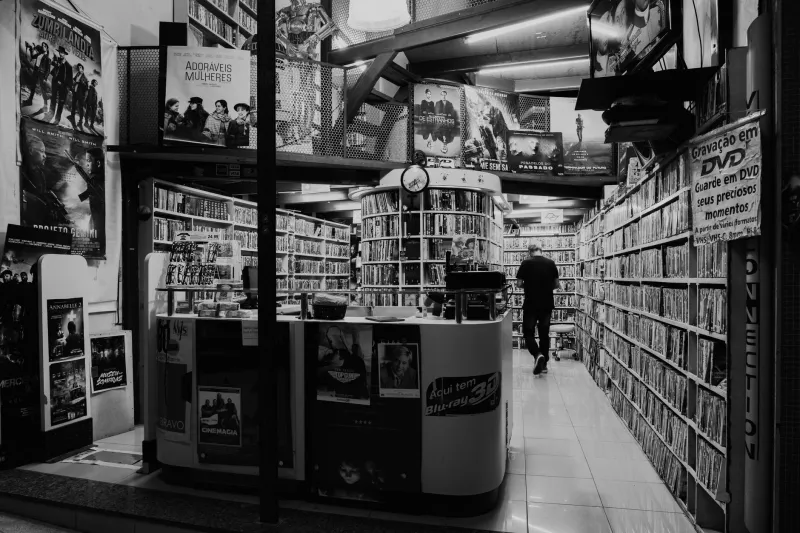
Walk into the Bend Blockbuster and you're immediately confronted with something no app has ever shown you: everything. Not a personalized row of twelve titles engineered to match your last three clicks. Not a homepage that reshuffles itself the moment you hesitate. Just... walls of movies. Comedies next to thrillers next to that weird direct-to-video sequel you forgot existed.
Browsing a physical shelf is a fundamentally different act than scrolling a feed. Your eyes catch spines. You read back covers. You pick something up because the cover art is ugly in a charming way, or because you remember your cousin mentioning it in 2007. Psychologists call this "serendipitous discovery," but that's a fancy term for something simpler: finding something you weren't looking for.
Algorithms, by design, can't do this. They're built to give you more of what you already chose. A shelf gives you the thing you never would have clicked on — and occasionally, that's the movie you end up loving.
The Clerk Is the Original Recommendation Engine
Here's where the Bend store genuinely embarrasses Silicon Valley. The staff there don't just check out your rental. They talk to you. They ask what you've seen lately, whether you want something funny or something that'll wreck you, and then they make a call. A human call, based on a thirty-second conversation.
Compare that to the "Because you watched..." rows on every major platform, which mostly tell you that the algorithm noticed you watched one thing. There's no back-and-forth, no clarification, no "okay, but did you like it or just finish it?" A good video store clerk — and Bend's are famously good — is doing real-time, conversational curation that no recommendation model has come close to replicating.
It's worth sitting with that irony: the most beloved recommendation engine in American entertainment is a person in a blue vest who gets paid to watch movies.
Friction, It Turns Out, Was Doing Something
Streaming sold us on the death of friction, and honestly, it delivered. No late fees, no drives, no "sorry, that one's checked out." But friction did something subtle. Choosing a movie used to be a decision with a small cost attached — you drove there, you picked one, you committed. That commitment made the viewing feel like an event.
Now, a Friday night looks like this: forty-five minutes of scrolling, half a pilot episode, a documentary trailer, then a different documentary, then bed. Nothing stuck because nothing cost anything. The tiny effort of driving to a store in Bend and renting a disc forces a decision, and decisions are where enjoyment actually starts.
There's a reason people report remembering movies from their video store era more vividly than anything they've streamed recently. Effort bonds us to experiences. It's the same reason a concert feels bigger than a livestream.
What Hollywood Could Actually Steal From Bend
Nobody's arguing that streaming should reopen 9,000 stores. But there are lessons here that platforms keep ignoring:
- Show everything, not just the profitable stuff. Physical shelves don't bury mid-budget comedies. Catalog titles get equal billing with new releases, which is why people stumble onto them.
- Recommendations work better as conversations than predictions. Even a simple "tell me what mood you're in" prompt would beat a row of algorithmic guesses.
- Make choosing feel like part of the fun. Curated collections, human picks, actual categories with personality — anything that treats the browse as an experience instead of a funnel.
The Bend Blockbuster isn't thriving because of nostalgia alone, though nostalgia certainly fills the parking lot. It's thriving because it accidentally preserved a version of movie-watching that streaming optimized away: the shelf, the stranger's opinion, the commitment to a choice.
The rest of the entertainment industry built the most convenient delivery system in history and, somewhere along the way, forgot to make it fun. One store in Oregon never got that memo. Maybe that's why it's still standing.